Getting there, what you see and what to do
Visiting a Sema ceremony
How to reach the Hodjapasha Culture Center in Sirkeci, how the hour unfolds in seven parts, what you hear, and the rules on photos, children and access.
Check dates and availability ↗Quick answer
Go to the Hodjapasha Culture Center in Sirkeci and check in 30 minutes before the show time. The ceremony lasts about an hour and follows seven parts, from a eulogy and a drum beat to four whirling salutes and a prayer. Stay silent, do not applaud, and keep your phone away: photography is prohibited. The venue states no dress code. Children under 7 cannot attend, and it is not suitable for wheelchair users.
Getting there
The venue's address is Ankara Caddesi, Hocapaşa Hamamı Sokak No: 3.B, in Sirkeci, in the Fatih district of Istanbul. Sirkeci is the area around Sirkeci Terminal, where the tram, the Marmaray rail line and ferry piers meet, so you can arrive by several routes. Enter the street address in your map app rather than relying on a landmark; searching the venue's name, Hodjapasha Culture Center, also works, since Wikipedia describes it as a restored Ottoman hammam in Sirkeci. The venue's own site places it near Hagia Sophia and Topkapı Palace, which makes it easy to pair with a day of sightseeing in the old city.
Arrival and timing
The venue's site says to check in 30 minutes before the show time, and the programme itself lasts about an hour. The booking calendar and your confirmation show the time for your date, so go by those rather than by a time you read elsewhere. The venue presents the ceremony as an everyday programme. Seats are allocated first-booked, first-served, so booking early matters for your seat, and arriving on time matters for the room: the ceremony needs a silent, tranquil atmosphere, and a late arrival disturbs it.
What you'll see: seven parts
The venue's site describes the Sema in seven parts. The hour is a fixed sequence rather than free movement, so you can follow it as it goes. The programme is a ritual with a set order that comes from the Mevlevi tradition, and it ends with a Fatiha and a prayer. In the list below, the numbering is the venue's own. Parts one to four are the opening, part five is the whirling most visitors come for, and parts six and seven close the rite.
- First: a eulogy to the Prophet, and the dervish removes his black cloak
- Second: a drum voice, symbolising the divine order "Be"
- Third: an improvisation on the ney, the reed flute
- Fourth: the dervishes' greeting, soul to soul
- Fifth: the whirling itself, in four salutes called selams
- Sixth: a reading from the Quran
- Seventh: a prayer for the repose of the souls of all prophets and believers
Reading the costume and the turn
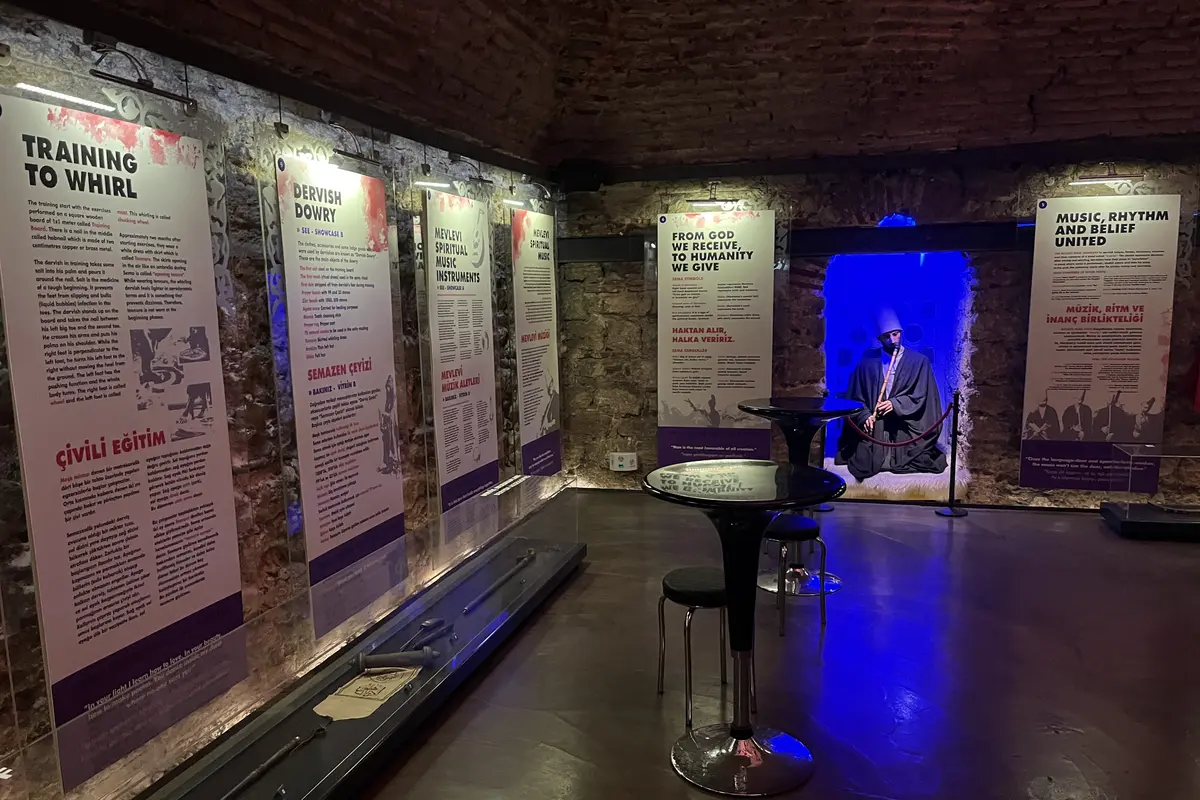
Each garment carries a meaning, according to Wikipedia's account of the Mevlevi order. The black cloak symbolises death and the grave, and it comes off before the whirling. The tall brown hat, the sikke, symbolises the tombstone and the death of the ego. The white robes beneath symbolise resurrection. The whirling is counter-clockwise: the right foot propels the body while the left stays rooted as an axis, with the right palm raised to receive grace and the left turned down. UNESCO adds that eyes stay open but unfocused, so images blur.
What you'll hear
The music is a composed repertoire called the ayin. UNESCO describes it as based on four sections of vocal and instrumental pieces, performed by at least one singer, a ney player, a kettledrummer and a cymbal player. The ney, a reed flute, represents the divine breath, and the programme begins with a concert of classical Turkish music. Do not expect a tune you can hum or a loud finish. The music is written to serve a ritual, and it follows the stages of the ceremony.
Etiquette: what is and isn't allowed
The rules are short. Photography inside is not allowed. Talking during the ceremony is not allowed. Applause is not allowed. The venue's site adds that the ceremony requires a silent and tranquil atmosphere, and that no disruption to the performance is permitted. The reason is that the Sema is a form of prayer, and clapping would turn it into a performance. If you want to show appreciation, do it afterwards, quietly. Keep your phone on silent and put it away before the ceremony starts.
What to wear
The venue's site lists its dress code as none, so you do not need to cover up to be admitted. Because the ceremony is a religious rite, plain, covered clothing is a courtesy that many visitors choose, but it is your decision. The venue does not list a shoe rule, so wear what is comfortable for sitting for an hour. Bring nothing that rustles or beeps. Bottled water is included, so there is no need to carry your own.
The exhibition and the booklet
The booking is titled Show & Exhibition. The venue's site describes the exhibition as information displays about dervishes and their ceremony, objects from the dervish world such as clothing, musical instruments and personal tools, and books. It also lists interactive Rumi poems, samples of Sufi music, hyperrealist statues of dervishes and video shows. The ticket also includes a programme booklet and bottled water. Your confirmation will tell you what is open and when, so read it before you set out rather than assuming.
Children, access and language
Children under 7 are not permitted at the dervish ceremony. Wheelchair users are listed as not suitable. The ceremony is an hour of quiet ritual with no applause, so judge whether older children can sit still that long. English is the language option on the booking calendar, and the programme booklet is there to explain what you are watching. For anything specific, such as seating or a group booking, contact the venue before you book. Its site lists a phone number and an email address, and it states that seats are allocated first-booked, first-served.
Rumi, in short
The ceremony belongs to the Mevlevi order, which was founded in 1273, after the death of the poet Rumi, by his followers, particularly his son Sultan Veled. The venue's site gives Rumi's birth as 30 September 1207 in Balkh, in present-day Afghanistan, and his death as 17 December 1273 in Konya, where a shrine stands over his grave. The Mevlevi call that night Seb-i Arus, the night of union, and the order's central ceremony each year is held in Konya. In Istanbul you see the same ritual form in a city setting.
Read next: Rumi and the Origins of the Mevlevi Order
Who this isn't for
This is not for anyone who wants to film or photograph the ceremony, because that is not permitted. It is not for families with a child under 7, or for wheelchair users. It is not for anyone who wants an entertainment show with loud music and applause; the venue's Rhythm of the Dance programme is its answer to that. And it is not for visitors who want a long devotional evening in a working lodge. UNESCO notes that many ceremonies are now performed for tourists in shortened form, and this scheduled programme is part of that pattern.
Frequently asked questions
How long is the whirling dervish ceremony?
About one hour. The venue's site gives 60 minutes for the dervish ceremony, and asks you to check in 30 minutes before the show time. Your confirmation shows the time for your date.
Can I take photographs during the ceremony?
No. The venue states that photography is not allowed in the dervish ceremony. Talking and applause are also prohibited. Keep your phone away for the whole programme.
What should I wear?
The venue's site lists no dress code. Because the ceremony is a religious rite, many visitors choose plain, covered clothing as a courtesy, but it is not a requirement for entry.
Can children attend?
Not under 7. The age limit for the dervish ceremony is 7. For older children, consider whether they can sit silently for about an hour, since the ceremony has no applause and no talking.
Is the venue wheelchair accessible?
No. The venue lists the dervish ceremony as not suitable for wheelchair users. Contact the venue directly if you have a specific question about access.
What happens during the ceremony?
It follows seven parts: a eulogy to the Prophet, a drum beat, a ney improvisation, the dervishes' greeting, four whirling salutes, a Quran reading and a closing prayer.
Sources